
Exploring Hong Kong
All the sights we saw, as well as everything we ate in Hong Kong
Hong Kong touches a particular regret of mine. I had a very close aunt who worked and lived in Hong Kong. Whenever we flew to Shanghai, she would also fly to Shanghai to spend time with us. She always talked about taking me to Hong Kong so she could show me around, but it was so hard to plan. Back then, we had a much larger family, before so many people passed. We dedicated a lot of time during each trip to China to visit a lot of people.
There weren't that many trips to China. Growing up, we didn't travel often. My parents saved money for necessities. As far as traveling, we usually always went to Shanghai to visit family, which was a grand total of 3 times by the time I was 18.
Even though it is so close, there was never any time left for a side trip to Hong Kong. Seven years ago, my aunt passed, and all our plans together went with her. To be honest, I had long figured we wouldn't be able to make this trip happen, because she had gotten sick years ago.
As a child, I naively asked her is Hong Kong clean? She replied of course, cleaner than China. That was the '90s. Shanghai wasn't as shiny as it is today. Hong Kong is probably grungier today than it was 30 years ago. Since this was my first time in Hong Kong, I didn't mind a little grunginess. I was happy to see evidence of some of the character left behind from years past.
For starters, it was very easy to get an Octopus card at the airport. We started using it immediately to ride a big red bus from the airport into the city, which was 34.60 HKD, ~$5 USD. Octopus is quite essential. Some restaurants might not accept credit cards, but do accept Octopus for payment.
Sights

We planned to come up here around sunset to catch a semi daytime and nighttime view, but by the time we walked over here, the sun had already come down. Though touristy, and the experience feels a lot like going through turnstiles for a Disney ride, the view from the top is very nice. It feels somewhat like an oasis from the rest of the city. Maybe because of the night air and the greenery, it felt a lot cooler up there.
I had the intention of learning just what are all these buildings in the skyline, and what I am looking at. After looking at the signs explaining the skyline, I still don't remember.
We took the Tram up to the peak, which I believe is 108 HKD roundtrip, or under $15 USD. You'd probably save money prepaying online or something, but I didn't think to do that. I also think they have too many options because they're trying to upsell you on priority and the Sky Terrace. I overlooked all these options, and just paid for the tram ticket with the Octopus card. Tap & go eliminates overthinking.
It's impressive just how steep the ride is. It is also ... um... impressive how aggressive some people are to get on the tram. Even though the line wasn't that long, and it looked like there was enough space for all of us to get on the next tram, there were still some people who insisted on pushing ahead of us. I don't know what they have gone through in their lives to practice this type of behavior. It's not worth the effort to fight them over a seat. When we were getting off the tram, they did have to wait for me to get out of the way, since we were filing off the tram in the same direction. I made an effort to be as slow as possible.
We usually like to frequent history museums to learn about the local community, who were the people that inhabited the land in the past, and how it became what it is today. Well we didn't get a lot of that here. Maybe we would have had better luck at the Hong Kong Heritage Museum.
Instead, there were many examples of propaganda here. Well I'll upload some photos I took, and anyone else can be the judge of that.
To start off, the 'national security' exhibit had some strong messages about what social stability looks like. There were four major themes that I noticed in the museum:
national security
Japanese brutality
protest movements
overseas Chinese
National Security
Protecting peace is typically a good thing. Here it appears the definition of national security depends on who could be a threat to peace, or perhaps who is a threat to those in power, including prohibiting 'sedition' and 'subversion' against the central government, to 'safeguard national security.'

This same message of 'safeguarding national security' is carried throughout the national security exhibit, as well as throughout the entire museum.

There were quite a few mentions of foreign influences that 'infiltrated the city' with 'anti-China' sentiment, which were used to describe the recent movements of Hong Kong independence. The Hong Kong National Security Law was credited for putting an end to it, and 'transitioning Hong Kong's situation from chaos to order.'

The Hong Kong National Security Law was credited for putting an end to it, and 'transitioning Hong Kong's situation from chaos to order.'

I didn't see much explanation in this exhibit about the Hong Kong protests, or 'chaos' as they described it, that arose due to sentiment around the extradition laws. To me, it is pretty clear whose narrative is being shared in the National Security Exhibition Gallery.

I wonder what the vision of "One Country, Two Systems" will look like as time goes on.
Japanese brutality
A lot of history museums in Asia dedicate an exhibit to atrocities by the Japanese, and hard fought battles that usually result in Japanese occupation. This was so common practice for the Japanese that I would be surprised if the WW2 occupation wasn't mentioned here.

Perhaps the British did try to fend it off, but they probably thought it was Asians fighting Asians, and washed their hands of the situation until after the Japanese surrendered in 1945.
protest movements
It's interesting, to say the least, to see this interpretation of the protests that took place in Hong Kong in recent history.

I'd love to hear it from the locals' perspective, but it's probably best not to invite that hardship into their lives now.

While I think 'colour revolutions' are not necessarily bad if they are peaceful protests, but the statement here clearly leads people to believe that 'revolution' should be prevented.

It's also interesting that there is almost no English translation in this section of the museum, but almost all of the other exhibits do.
overseas Chinese There was a lot of mention of Chinese people moving overseas, especially to California, and a lot of them made their way from Hong Kong or Macau.

33 days from Hong Kong to San Francisco seems like forever.

It sounds like no Chinese person ever struck it rich during the gold rush, but formed the start of a Cantonese community in California.

There was a lot of mentions of migrants from Hong Kong to San Francisco.

I wonder if the relationship between these two cities was stronger back then than it is now.

Of course Chinese people were in the U.S. for cheap labor. Without strong labor demand, what good are we?

Did the non-Chinese people expect the Chinese to go home after the completion of the Transcontinental Railroad? Certainly no one planned for them to stay.

A little nauseating to see a publication named 'The Wasp' WASP : white Ango-Saxon person

No story about Chinese American history is complete without mention of the Chinese Exclusion Act.

Replications of immigration investigation rooms with audio represented what an interview looked and sounded like back when Chinese immigrants had to prove their legitimacy to stay in the U.S.

Life must have been really harsh for people to become experts at falsifying identity and stories just to enter the U.S. I guess the 1906 fire has a silver lining in burning up the government files.

This was particularly interesting to me because one of my aunts was a telephone operator in the '90s.
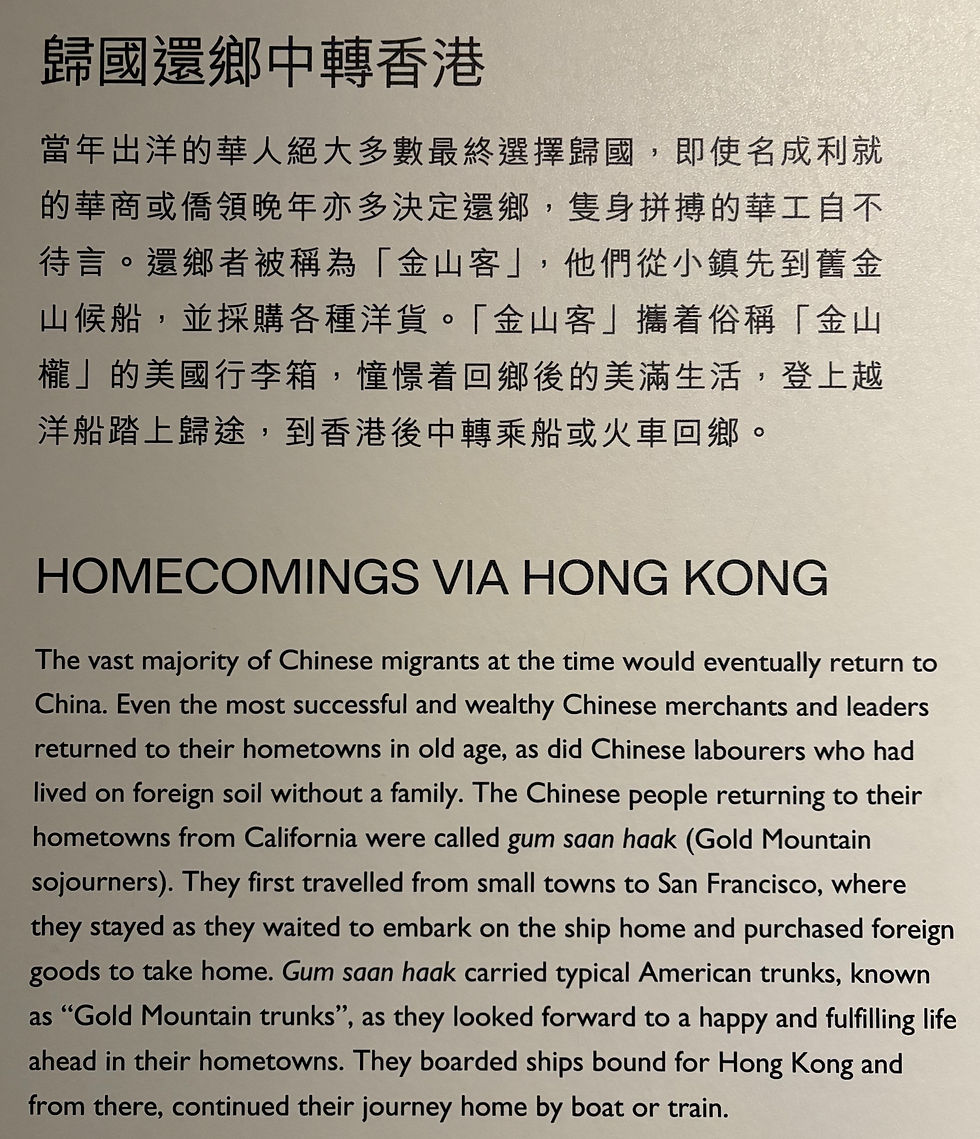
I hope they received warm welcomes home.

Well of course the Chinese Exclusion Act was repealed when they need something from the Chinese. 'Equal treatment' and the rest of this paints a rosy, picturesque ending, but doesn't have any indication of the bamboo ceiling.

An apology is better late than never, I suppose.

I realized I had traveled across the Pacific Ocean to look at pictures of California.

Like I said, there was a lot of emphasis on the Chinese community in California, especially Los Angeles and San Francisco.

Good thing this museum is free, so we didn't have to pay to read propaganda and look at pictures of San Francisco, our hometown. Others: Perhaps the fifth theme I should have noted is British colonization. See below.

Imagine this blaring on the speakers as you walk in.

When a country is forced to give up land of any kind, isn't it typically always done with military aggression? Why is it when it is done to China that it is considered 'unequal'? Though I wouldn't assume that being forced to give up a territory is ever considered 'equal.'

If the "unequal treaties" were never "legally binding," then did Hong Kong ever need a real "return to the Motherland"? Just curious

This museum was very interesting. Despite learning a lot, I couldn't shake the feeling that it didn't represent enough of the local people's point of view. The very pro-China agenda set a tone. Nevertheless, we wanted to explore the entire place. We left halfway through because the air conditioning was very cold so went to get a snack. Then we returned to resume learning about Japanese war crimes and overseas Chinese people.

I only recently learned that campus climbing or 'campusing' means to climb with your upper body. Sounds too hard to me. Tim enjoys climbing in different gyms around the world. I tag along because I'm curious to see how they differ from place to place. Some could be cleaner, or should aim to be cleaner.

The famous Tony Leung was here. Just kidding I don't really know anything about Hong Kong's famous acting community. It is very lovely to take an evening stroll here. It was far to hot here last October.

Riding the ferry back to our hotel was a nice way to end our trip in Hong Kong. We were very lucky to experience hardly any rain during our entire trip.
Eats
Cheung Hing Kee Shanghai Pan-Fried Buns: 祥興記上海生煎包

our first meal, or snack in Hong Kong, because we love 生煎包, fried buns

We got the most expensive set, with 2 of everything; signature, shrimp, mala, black truffle, and crab roe. 169 HKD, ~$22 USD I suppose it's not that expensive for 10 of these, but we definitely felt the impact of HK's pricing, especially compared to Taipei and Shanghai.

I didn't have high expectations, because it was the end of the day. They were wrapping up for the night. The griddle was already turned off. These weren't as fresh or as hot as we would have liked. However, they were still juicy, flavorful, and crispy. I would come back to try them again earlier in the day.
HongKongHungHingLong Chinese Restaurant Sadly this place is closed. I'm surprised because we were here just a mere few months ago. The ladies here were so nice.


The food was simple and delicious. These wontons were very big and juicy. I made a mental note that we're in Cantonese land, and here it is yuntun 云吞, whereas in Mandarin it is huntun 餛飩.

I genuinely don't understand why there are so many Michelin stars in Hong Kong. A lot of them seem like normal restaurants.


Our first family style dimsum meal with some friends. We got the squab because we heard it is one of their specialty items. The food was not bad. It did take us a minute to find the restaurant in the basement of an older shopping mall. When we descended the stairs, there was a little construction going on, so we briefly wondered if this restaurant was still here, but we found it once we rounded a corner.

I'm sorry, but this was kind of disappointing. This place has a lot of good reviews. It's also a bit grungy, cramped, and old, which are all the markings of what you'd expect from a restaurant with delicious, tasty food. However, the meats were too fatty. We got a couple plates with roasted goose and pork. Some pieces were large chunks of fat, and not a lot of meat. One of our plates was missing a LOT of skin, but the skin wasn't that crispy anyway.

Signature Milk Tea (Hot), 招牌奶茶(熱) Signature Milk Tea (Hot), 招牌奶茶(熱): 16 HKD, ~ $2 USD

Steamed Spare Ribs with Black Bean Sauce, 豉汁蒸排骨 Steamed Spare Ribs with Black Bean Sauce, 豉汁蒸排骨: 30 HKD, ~ $4 USD

Hometown-Style Salted Dumplings, 家鄉咸水角 Hometown-Style Salted Dumplings, 家鄉咸水角: 28 HKD, ~ $4 USD

Emerald Green Shrimp Balls, 碧綠鳳尾蝦球 Emerald Green Shrimp Balls, 碧綠鳳尾蝦球: 42 HKD, ~ $5 USD

Baked Barbecue Pork Buns with Crispy Crust, 酥皮焗叉燒包 Baked Barbecue Pork Buns with Crispy Crust, 酥皮焗叉燒包: $35 HKD, ~ $5 USD

On our last day in Hong Kong, we came to the famous Tim Ho Wan for breakfast out of convenience more than anything else. The restaurant was in a mall connected to our hotel. It looked pretty busy, but the wait wasn't long. The dim sum was pretty good. Everything was pretty good quality, but I still can't understand why it is Michelin worthy. Of course we got the famous baked pork buns. They're pretty good and I usually think these type of buns with the sticky red glaze is too sweet. We also got tea, which was about 8 HKD, ~ $1 USD per person. Total: 169 HKD, ~$22 Surprisingly affordable!Total


butter cookie crust egg tart 
puff pastry egg tart I wanted to try the egg tarts 蛋塔 from the famous Tai Cheong. Tim did not love these. He said the crust wasn't that good and flavorless, which probably means not sweet enough. I can't decide which crust I like better. Maybe the butter cookie was better, because the puff pastry wasn't that flaky. Also the pineapple buns were too dense and kind of dry.


After a couple of disappointing pineapple buns 菠蘿包, I almost gave up. I didn't want to waste valuable stomach space on dense unsatisfying pastries. Then our friend recommended this place. Finally a pineapple bun that was soft and fluffy on the inside, not too bready. The crust is good, but with mostly sugar and butter, how could the crust be bad? I noticed that she gave me the wrong pastry. I noticed when I was right outside the bakery. I considered just purchasing it on top, but then I told her I actually want the pineapple bun. She just reached into my paper bag with her tongs and swapped it out. No problemo. Best part? This is very cheap! 5 HKD, ~ $0.64 USD


Peach Earl Grey and Cold Brew Peach Earl Grey Iced Tea: 28 HKD, ~$4 USD Cold Brew: $60 HKD, ~$8 USD very expensive cold brew It's a grab and go place, so we perched ourselves outside to eat. I was very bummed when I accidentally knocked over Tim's cold brew. I ran in to buy him a replacement, and experienced a bit of sticker shock. It might be the most expensive thing in there.


salted egg caramel pineapple bun Salted Egg Caramel Pineapple Bun: 28 HKD, ~ $4 USD How many bites do you think it took to get to the filling?

maybe 4-5 bites The filling is nice to break up the bread. This is pretty expensive for a mini bolo bao. Honestly the bread was also dense and dry, but the filling helps.

sourdough egg tarts and salted egg caramel bolo Sourdough Egg Tart: 14 HKD, ~ $2 USD This is probably the best thing. Just get this. Skip the rest. Tim loved these egg tarts the best. He said the filling had a lot of flavor, very creamy consistency, and great crust. Total: 158 HKD, ~$20 kind of expensive breakfast, almost as expensive as the U.S.


Tim said he was tired of Cantonese food, so had a light lunch at this casual izakaya spot. The food is pretty good and it's a nice place to relax.
Bar Leone Yes I was curious to try the World's Best Bar. It's silly that these lists exist.

Bar Leone We got in line at about 4:30 PM on a Thursday. It's not surprising that most people were visitors. Even though Bar Leone doesn't take reservations, some people kept showing up and getting seated ahead of all the people in line. They kept telling everyone that they were there for a private party. It already didn't seem very honest, because it's not super realistic to have a 'private party' in a small bar. Then we heard one party getting 'squeezed in.' If they truly had plans for a 'private party,' they would have planned for this party, and wouldn't have to squeeze their party in ahead of all the people in the line. Some of them were speaking Italian, so we got the sense that they were getting preferential treatment at an Italian bar. It felt a little disrespectful to the other patrons.

World's Best Olives We finally got seated at about 5:30 PM. Every time we go to one of these bars on the 'World's Best' list, we end up chatting with strangers and making a new friend. He was a young guy enjoying solo travels. We didn't order their 'World's Best Olives,' but he did and shared them with us, and we shared our fries with him. I don't even like olives that much, but these were great, almost savory and meaty.


drinks and tartare 
Il Cacciatore - cherry tomato & basil, lemon, botanist gin, bianco vermouth, mastika Il Cacciatore: 130 HKD, ~ $17 USD fantastic sweet and umami flavor

Caffe' Paradiso - dark roast cold brew coffee, honey, amaro lucano, salted cream, green cardamom Caffe' Paradiso: 140 HKD, ~ $18 USD nice hit of mixing uppers and downers classic Tim behavior to order a variation of an espresso martini

Steak Tartare with sun-dried tomato mayo, pane carasau Steak Tartare: 190 HKD, ~ $24 USD I'm a sucker for steak tartare. The meat itself was good. The pane was alright, a tad dry, and not the best vehicle for steak tartare, cuz it breaks.

Marsellus Wallace - cantaloupe & lime, Montelobos mezcal, apertif wine, tajin Marsellus Wallace: 130 HKD, ~ $17 USD so good, mezcal is sweeter than most

Fries Arrabbiata Fries Arrabbiata: 98 HKD, ~ $13 USD Not bad, but not that much of a kick for something with arrabbiata in the name

Olive Oil Sour - Italian olive oil, Woodford Reserve whiskey, marsala, lemon, honey, egg white Olive Oil Sour: 160 HKD, ~ $21 USD Since we're in an Italian bar where they're proud of their olives, how could we not order an olive oil sour?

Il Cacciatore We enjoyed the drinks, but there was pretty clear favoritism with their service. There's also a 10% service charge. What are we, in SF? Total: 933 HKD, ~ $120 USD
Coa I believe the wait here is not as long. There was only one person in front of us, so we got seated in the first round. An older couple behind us were taking pictures, almost like a photoshoot. The husband kept having his wife pose in her dress and heels, saying 'ho leng ho leng.' How sweet and how cute!

Coa They asked what was our preference and we chose the bar, because it's fun to watch the bartenders practice their craft.

menu 
Coconut Milk Punch - tamarind, rum, sherry, coffee, coconut, pineapple, cardamom Coconut Milk Punch: 128 HKD, ~ $16 USD very islandy, slightly tart and with coconut flavor, but not too much, so not heavy

Mole Negroni - cacao husk, vermouths, campari, tequila reposado, poblano Mole Negroni: 128 HKD, ~ $16 USD It already tastes pretty good, but after you take a bite of the chocolate they stick to the glass, it enhances the flavors, both cacao and smokiness.

Al Pastor Tacos - pork, pineapple, onion, salsa verde, radish Al Pastor Tacos: 112 HKD, ~ $14 USD
nice and smoky al pastor, and the tortillas were just soft enough Maybe the pineapples could have been torched for more sweet and smoky flavors. surprisingly good tacos in Hong Kong

Shrimp Tacos - shrimp, guajillo, pineapple, guacamole, crema, radish Shrimp Tacos: 125 HKD, ~ $16 USD These were pretty good too with juicy shrimp, and I like when jumbo shrimp are glued to the tortilla with some guacamole or crema.

Crimson Swirl - pomegranate, mezcal, port, strawberry, chili, Chinese vinegar Crimson Swirl 128 HKD, ~ $16 USD I was curious to try how the Chinese flavors would work in this, but the tartness, acidity, and spiciness play very well with the sweetness.

Smacked Cucumber - cucumber, Chinese salad sauce, lime, ginger honey, chili, mezcal Smacked Cucumber: 128 HKD, ~ $16 USD I think this might have been my favorite. It really does taste like a cucumber salad in cocktail form, but more refreshing.

Quesadilla - flour tortilla, Oaxacan cheese, crema, guacamole Quesadilla: 118 HKD, ~ 15 USD This was probably the least interesting thing we ordered, because it's kind of expensive for what it is. I think the cocktails here are far more creative, inventive, and unique than the ones at Coa. Service was also much nicer, more attentive, but not overbearing, and overall just much more operationally organized. They also have a 10% service fee. Oh well. Total: 954 HKD, ~ $122 USD
Shari Shari Kakigori House: Shari Shari 氷屋


so delicious and creamy and refreshing on a hot hot day The super thin sheets of ice were molded into a ball and soaked in matcha.

Hojicha Parfait - 焙茶牛乳雪糕杯 Hojicha Parfait: 58 HKD, ~ $7 USD Clearly I'm into the matcha desserts. This was so good too. Not too sweet 😉
Accommodations
We used up the last of our free Hyatt Category 1-4 nights. Good thing Hong Kong has Category 4 hotels. This hotel is a little on the older side. It also feels a bit stuffy without the air conditioner on. I think the building needs help with air circulation. Of course the hotel has all the essentials, and the bed was comfortable enough. They provide slippers. The bedroom and bathroom are quite spacious too, though the design is pretty old school. It's not bad, but you feel the difference after a week of bathrooms with Japanese toilets. Here were some oddities. First, the mirror has a panel running through it. I'm a short person, but at that height, the panel would prevent most people from seeing their face, which makes this mirror pretty useless. I wonder if it is hiding some cracks. There is also a very tiny closet, which also serves as a throughway between the entrance and the bathroom. I can't imagine anyone walking through the closet into the bathroom. Perhaps it's meant to help with air flow into the bathroom?
One thing I noticed about Hong Kong is it is very dense. Maybe not so much in like a shoulder to shoulder with people type of way, but it is plain to see the living conditions are tight. The livable land is packed with high rises, old and new. Another thing I noticed about Hong Kong is there seem to be quite a lot of Mandarin speakers. Sure a lot of people are tourists, and I know the mainland is right there. I don't speak Cantonese, but when I mentioned this, the waitress switched to Mandarin. I half expected her to speak English only because so many people told me that everyone speaks English and Cantonese in Hong Kong. Hearing service staff switch to Mandarin happened several times, so I am curious if it is more so due to a rising influx of Mandarin Chinese laborers or if the PRC is making a more concentrated effort to make Mandarin the main language here too.
I hope to see Hong Kong again. I need to try more food, and could probably use better recommendations. I'd also visit a different museum next time, though free propaganda is a nice form of entertainment sometimes. Until next time Hong Kong!
Comments